

May 20, 2026
Many people work alone as part of their day-to-day role. This might mean travelling between sites, working outside normal hours, or carrying out tasks without colleagues nearby.
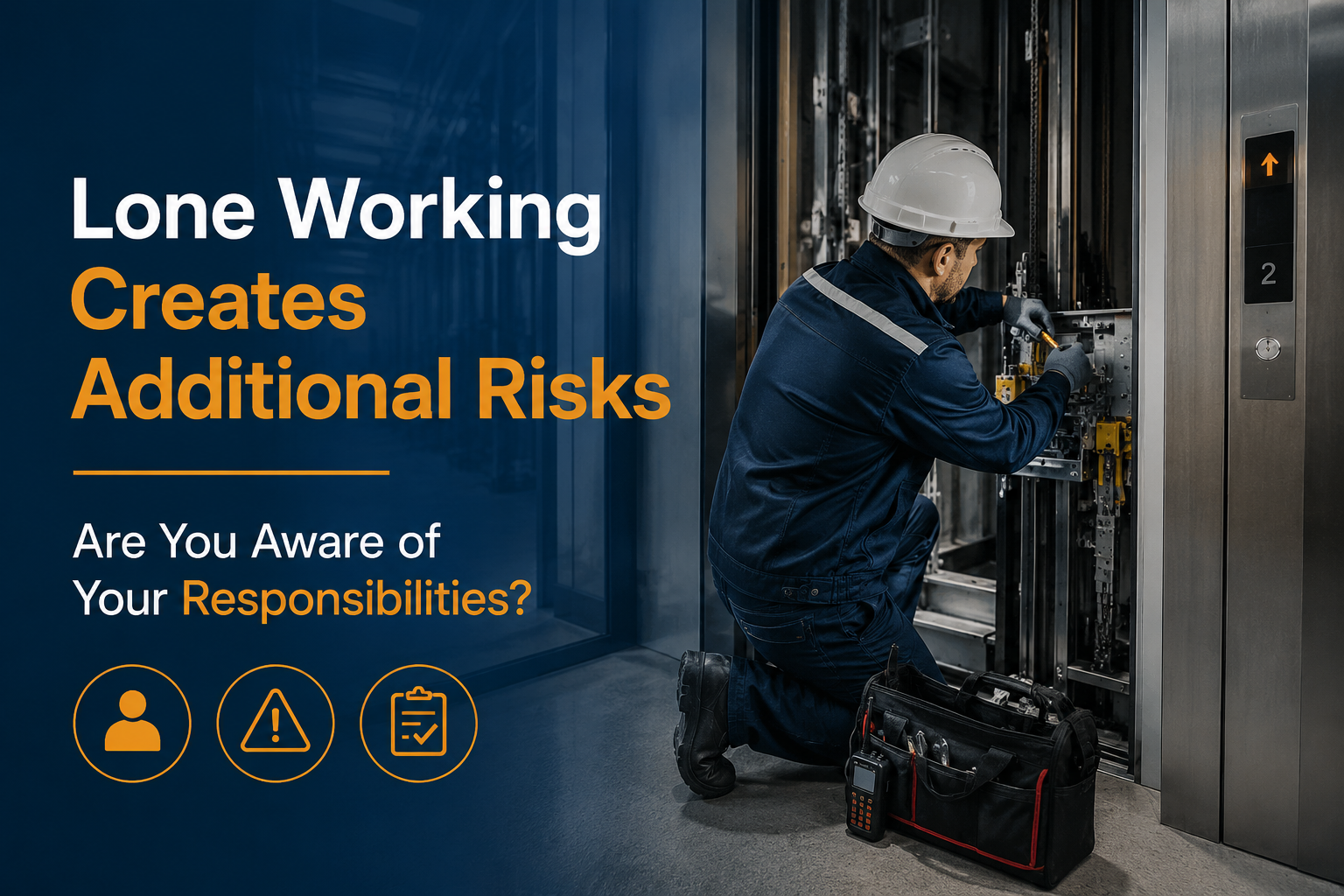
In the lift industry, this is particularly common. Engineers, maintenance staff and inspectors often attend client premises on their own, working in plant rooms, service areas and other locations where immediate help may not be available if something goes wrong.
Working alone can create additional risks. If an employee is injured, becomes unwell or encounters a problem on site, it may take longer for support to reach them.
In this article, we explain what lone working means, the main risks employers should consider, and the practical steps you can take to help keep your workforce safe while ensuring your insurance arrangements reflect the way your business operates.
What counts as ‘lone working’?
According to the Health and Safety Executive (HSE), a lone worker is someone who works by themselves without close or direct supervision.
That doesn’t necessarily mean working in complete isolation. Lone working can include:
- An engineer attending a site alone
- A maintenance worker visiting multiple premises during the day
- An inspector working in a plant room or other quiet area
- Someone working early, late or outside normal hours
- An employee travelling alone between jobs
Although we’re focusing this article on the lift industry, the same principles apply across many sectors where employees regularly work on their own.
How does lone working increase risk?
The main challenge with lone working is that if something goes wrong, help may not be immediately available.
That doesn’t mean lone working is unsafe, but it does mean employers need to think carefully about the situations their employees may face.
Common risks include:
- Accidents and sudden illness or injury
- Equipment failure
- Working in unfamiliar premises
- Difficult interactions with members of the public or site staff
- Road-related risks when travelling between jobs
- Stress, fatigue or feelings of isolation
- Poor or unreliable communication systems
The level of risk will vary depending on the task, the location and the individual involved. The key is to identify where additional support or safeguards may be needed.
Employer responsibilities: what needs to be in place?
Under the Health and Safety at Work etc. Act 1974, employers have a duty to ensure, so far as is reasonably practicable, the health, safety and welfare of their employees.
This responsibility applies just as much to lone workers as it does to anyone working as part of a team.
What’s more, the Health and Safety Executive’s guidance on managing the risks of working alone explains that employers should assess lone working in the same way as any other workplace risk.
This typically includes:
- Carrying out suitable risk assessments
- Putting clear lone working policies in place
- Providing appropriate training and supervision
- Establishing reliable communication arrangements
- Creating and communicating emergency procedures
- Reviewing arrangements regularly, especially when work patterns or locations change
The key question is simple: if something happens, how will the worker get help?
Practical controls for lone workers in the lift industry and beyond
The good news is that protecting lone workers doesn’t usually require anything overly complicated. In many cases, a few practical procedures and the right technology can make a significant difference.
For employers in the lift industry and beyond, the following measures are often particularly effective:
Set up simple check-in and check-out procedures
Get employees to confirm when they arrive on site and when they leave. This could be done by phone call, text message, a mobile app, or by scanning a tag or code at the location.
Agree what happens if someone doesn’t check in or out
Everyone should know the next steps, such as phoning the employee, contacting the site, and escalating to emergency contacts if there is still no response.
Use suitable communication tools
A fully charged smartphone may be enough for some roles. Higher-risk work may justify a specialist lone worker device or app that can send an automatic alert if the employee needs help.
Provide site information in advance
Sharing details about access arrangements, known hazards, security procedures and emergency exits helps workers arrive prepared.
Keep contact details current
Managers should have up-to-date emergency contact information and employees should know who to call if they have concerns.
Be clear about when work shouldn’t be done alone
Certain tasks, locations or circumstances may require a second person to be present.
Make sure first aid arrangements are understood
Workers should know what to do if they’re injured and how to summon assistance quickly.
Encourage workers to pause and seek help if something doesn’t feel right
If site conditions seem unsafe or circumstances change, staff should feel confident postponing the job until additional support is available.
The most effective lone working arrangements are usually the simplest: clear expectations, reliable communication and a shared understanding that safety comes first.
Why insurance matters
Good procedures and precautions are your first line of defence, but insurance plays an important role in the wider protection picture.
The right cover can help protect your business if an employee is injured while working alone, if a third party is affected, or if an accident leads to a claim.
Depending on how your business operates, relevant policies may include:
- Employers’ Liability insurance – A legal requirement for most employers, this cover can help meet compensation claims if an employee is injured or becomes ill as a result of their work.
- Public Liability insurance – Helps protect your business if your activities cause injury to a third party or damage to someone else’s property.
- Personal Accident cover – Can provide financial support if an employee or business owner is unable to work following an accidental injury.
- Commercial Motor or fleet insurance – Important where employees travel between sites, as this may involve business use that needs to be declared to your insurer.
- Directors’ and Officers’ (D&O) insurance – Can help protect directors and senior managers if claims are made alleging that business decisions or management failures caused financial loss.
Insurance doesn’t replace the need for proper risk assessments and safe working procedures. However, it can provide valuable financial protection if something goes wrong despite your best efforts.
Insurers may also want to understand how lone working risks are managed, particularly where employees carry out higher-risk activities or regularly work in higher-risk environments.
In short, strong risk management and suitable insurance go hand in hand, helping to protect both your people and your business.
Lone working: a helpful checklist for employers
If your employees work alone, this simple checklist can help you review whether the right safeguards are in place:
- Identify which employees work alone and when
- Review the risks associated with the task, the site and any travel involved
- Set clear check-in and check-out procedures
- Agree what should happen if an employee misses a scheduled check-in
- Provide suitable communication tools
- Train employees on when to stop work and ask for support
- Keep records of risk assessments and lone working procedures
- Review your insurance arrangements regularly to ensure they still reflect how your business operates
Even small improvements can make a meaningful difference to worker safety and compliance.
Is your business properly protected for lone working?
From our specialist Lift Plan liability scheme, designed specifically for businesses in the lift industry, to a wide range of tailored commercial insurance services, Robert Gerrard, part of the Jensten Group, can help you access the protection and specialist expertise your business needs.
Being part of the Jensten Group also gives us access to a wider network of specialists and insurers, enabling us to support clients with more complex or hard-to-place risks.
If you’d like to review your lone working arrangements and make sure your insurance meets your needs, get in touch with Team RG today.
Share This Story, Choose Your Platform!
Many people work alone as part of their day-to-day role. This might mean travelling between sites, working outside normal hours, or carrying out tasks without colleagues nearby.
In the lift industry, this is particularly common. Engineers, maintenance staff and inspectors often attend client premises on their own, working in plant rooms, service areas and other locations where immediate help may not be available if something goes wrong.
Working alone can create additional risks. If an employee is injured, becomes unwell or encounters a problem on site, it may take longer for support to reach them.
In this article, we explain what lone working means, the main risks employers should consider, and the practical steps you can take to help keep your workforce safe while ensuring your insurance arrangements reflect the way your business operates.
What counts as ‘lone working’?
According to the Health and Safety Executive (HSE), a lone worker is someone who works by themselves without close or direct supervision.
That doesn’t necessarily mean working in complete isolation. Lone working can include:
- An engineer attending a site alone
- A maintenance worker visiting multiple premises during the day
- An inspector working in a plant room or other quiet area
- Someone working early, late or outside normal hours
- An employee travelling alone between jobs
Although we’re focusing this article on the lift industry, the same principles apply across many sectors where employees regularly work on their own.
How does lone working increase risk?
The main challenge with lone working is that if something goes wrong, help may not be immediately available.
That doesn’t mean lone working is unsafe, but it does mean employers need to think carefully about the situations their employees may face.
Common risks include:
- Accidents and sudden illness or injury
- Equipment failure
- Working in unfamiliar premises
- Difficult interactions with members of the public or site staff
- Road-related risks when travelling between jobs
- Stress, fatigue or feelings of isolation
- Poor or unreliable communication systems
The level of risk will vary depending on the task, the location and the individual involved. The key is to identify where additional support or safeguards may be needed.
Employer responsibilities: what needs to be in place?
Under the Health and Safety at Work etc. Act 1974, employers have a duty to ensure, so far as is reasonably practicable, the health, safety and welfare of their employees.
This responsibility applies just as much to lone workers as it does to anyone working as part of a team.
What’s more, the Health and Safety Executive’s guidance on managing the risks of working alone explains that employers should assess lone working in the same way as any other workplace risk.
This typically includes:
- Carrying out suitable risk assessments
- Putting clear lone working policies in place
- Providing appropriate training and supervision
- Establishing reliable communication arrangements
- Creating and communicating emergency procedures
- Reviewing arrangements regularly, especially when work patterns or locations change
The key question is simple: if something happens, how will the worker get help?
Practical controls for lone workers in the lift industry and beyond
The good news is that protecting lone workers doesn’t usually require anything overly complicated. In many cases, a few practical procedures and the right technology can make a significant difference.
For employers in the lift industry and beyond, the following measures are often particularly effective:
Set up simple check-in and check-out procedures
Get employees to confirm when they arrive on site and when they leave. This could be done by phone call, text message, a mobile app, or by scanning a tag or code at the location.
Agree what happens if someone doesn’t check in or out
Everyone should know the next steps, such as phoning the employee, contacting the site, and escalating to emergency contacts if there is still no response.
Use suitable communication tools
A fully charged smartphone may be enough for some roles. Higher-risk work may justify a specialist lone worker device or app that can send an automatic alert if the employee needs help.
Provide site information in advance
Sharing details about access arrangements, known hazards, security procedures and emergency exits helps workers arrive prepared.
Keep contact details current
Managers should have up-to-date emergency contact information and employees should know who to call if they have concerns.
Be clear about when work shouldn’t be done alone
Certain tasks, locations or circumstances may require a second person to be present.
Make sure first aid arrangements are understood
Workers should know what to do if they’re injured and how to summon assistance quickly.
Encourage workers to pause and seek help if something doesn’t feel right
If site conditions seem unsafe or circumstances change, staff should feel confident postponing the job until additional support is available.
The most effective lone working arrangements are usually the simplest: clear expectations, reliable communication and a shared understanding that safety comes first.
Why insurance matters
Good procedures and precautions are your first line of defence, but insurance plays an important role in the wider protection picture.
The right cover can help protect your business if an employee is injured while working alone, if a third party is affected, or if an accident leads to a claim.
Depending on how your business operates, relevant policies may include:
- Employers’ Liability insurance – A legal requirement for most employers, this cover can help meet compensation claims if an employee is injured or becomes ill as a result of their work.
- Public Liability insurance – Helps protect your business if your activities cause injury to a third party or damage to someone else’s property.
- Personal Accident cover – Can provide financial support if an employee or business owner is unable to work following an accidental injury.
- Commercial Motor or fleet insurance – Important where employees travel between sites, as this may involve business use that needs to be declared to your insurer.
- Directors’ and Officers’ (D&O) insurance – Can help protect directors and senior managers if claims are made alleging that business decisions or management failures caused financial loss.
Insurance doesn’t replace the need for proper risk assessments and safe working procedures. However, it can provide valuable financial protection if something goes wrong despite your best efforts.
Insurers may also want to understand how lone working risks are managed, particularly where employees carry out higher-risk activities or regularly work in higher-risk environments.
In short, strong risk management and suitable insurance go hand in hand, helping to protect both your people and your business.
Lone working: a helpful checklist for employers
If your employees work alone, this simple checklist can help you review whether the right safeguards are in place:
- Identify which employees work alone and when
- Review the risks associated with the task, the site and any travel involved
- Set clear check-in and check-out procedures
- Agree what should happen if an employee misses a scheduled check-in
- Provide suitable communication tools
- Train employees on when to stop work and ask for support
- Keep records of risk assessments and lone working procedures
- Review your insurance arrangements regularly to ensure they still reflect how your business operates
Even small improvements can make a meaningful difference to worker safety and compliance.
Is your business properly protected for lone working?
From our specialist Lift Plan liability scheme, designed specifically for businesses in the lift industry, to a wide range of tailored commercial insurance services, Robert Gerrard, part of the Jensten Group, can help you access the protection and specialist expertise your business needs.
Being part of the Jensten Group also gives us access to a wider network of specialists and insurers, enabling us to support clients with more complex or hard-to-place risks.
If you’d like to review your lone working arrangements and make sure your insurance meets your needs, get in touch with Team RG today.