

August 26, 2026
When you’re choosing insurance for your business, price inevitably matters. Nobody wants to pay more than they need to.
But the cheapest premium doesn’t necessarily represent the best value. If the cover doesn’t properly reflect your risks, or the policy isn’t right for the way your business operates, saving money at renewal could prove costly further down the line.
So, what should you expect from a good insurance broker?
A good broker does far more than find you a policy. They take the time to understand your business, explain your options clearly, challenge you when necessary and remain alongside you when you need them.
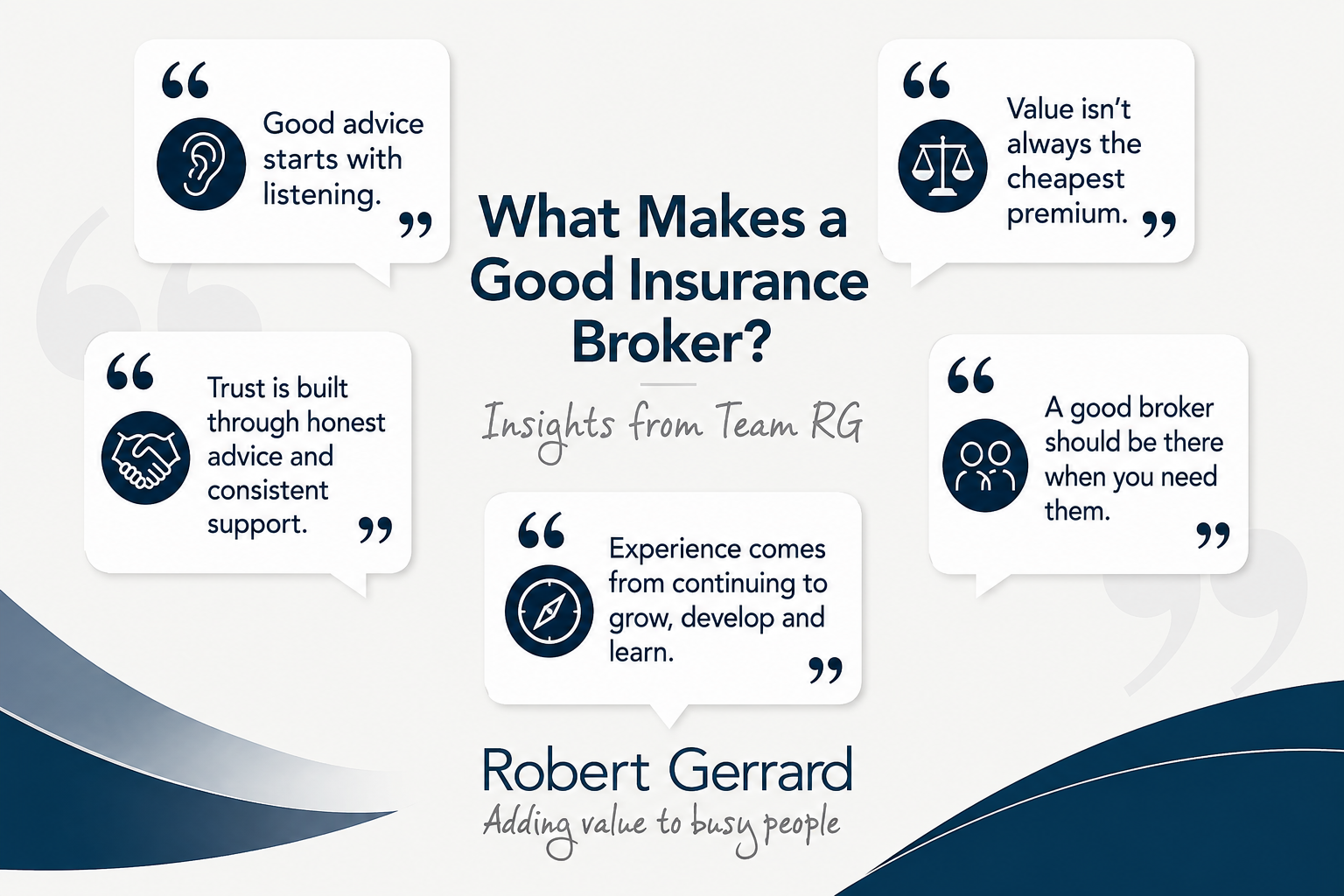
We asked members of Team RG what they believe makes a genuinely good insurance broker. Despite different roles and decades of combined experience, the same themes came up time and again.
1. They listen before they advise
Good advice starts with listening.
As one member of Team RG put it, a broker needs to understand what their client actually needs, rather than what they think they should need.
That means taking the time to understand what matters to you, from the level of cover and service you expect to the pressures and priorities affecting your business. But listening doesn’t mean simply agreeing. There may be times when what you’re asking for isn’t necessarily in your best interests. That’s where a good broker adds value, challenging assumptions where necessary and helping you make an informed decision.
Ask yourself: Does your broker really understand what you need, or do they simply know when your renewal date is?
2. They understand your business and your sector
Gary Atkins highlights the importance of understanding a client’s business and identifying which risks can be transferred to insurance, while recognising what the client wants in terms of cover, service and price.
Different industries face different risks. A lift contractor, construction company, property owner and professional services firm may all require commercial insurance, but their operations, contractual responsibilities and liabilities can be worlds apart.
A good broker will take the time to understand your operations, customers and contracts, as well as the wider challenges affecting your sector.
At Robert Gerrard, our longstanding specialism in the lift industry has shown us the value of genuinely knowing a client’s sector. Understanding the pressures businesses face makes for better conversations, better advice and better-informed decisions.
Ask yourself: Does your broker understand how your business makes money, where its responsibilities lie and what could potentially disrupt it?
3. They understand that value isn’t the same as price
When assessing your options, a good broker will look at overall value, balancing the quality and suitability of the insurer, the cover provided and the premium you’re being asked to pay.
The cheapest policy can quickly become an expensive choice if an important risk isn’t covered, your limits are inadequate or exclusions only come to light when you need to make a claim.
Insurers have different strengths, appetites and areas of expertise, and part of your broker’s role is knowing where your business is best placed.
Ask yourself: When your broker recommends a policy, do you understand why it’s the right choice for your business, beyond the price?
4. They’re honest, even when the answer isn’t what you want to hear
Good advice isn’t always the answer you were hoping for.
Trust and honesty came up repeatedly when we asked Team RG what they value in a good broker. For Tim Nurcombe, trustworthiness and the ability to give an honest response when called upon are fundamental, while Louis Moore-Nye believes trust is built through honest advice and consistent support.
Sarah Scotchmer, our Commercial Director, makes another important point:
“While it’s important to listen to what a client wants, there are times when we need to manage expectations and explain why what they’re asking for may not be in their best interests.”
That’s an important part of the broker-client relationship. Sometimes good advice means challenging assumptions, explaining the implications of a decision or recommending a different approach.
Honesty also means being open when something goes wrong. Having the humility to acknowledge a mistake and put it right can build far more trust than trying to gloss over it.
Ask yourself: Do you trust your broker to tell you what you need to hear, even when it isn’t necessarily what you want to hear?
5. They’re there when you actually need them
Your broker shouldn’t suddenly reappear when your renewal date does.
Good broking means providing support throughout the year, whether your business changes, you have a question about your cover or you need advice.
Nowhere is that relationship more important than when you need to make a claim. A good broker can help you understand what’s required, communicate with the insurer, manage expectations and keep the process moving wherever possible.
Just as importantly, they’ll already know your business and your history. You shouldn’t have to start from scratch at the very point when you most need support.
Ask yourself: If you needed to make a claim tomorrow, would you know exactly who to call — and would they know you?
6. They’re proactive as your risks change
Proactivity was another quality highlighted by the team. For Sue Pace, being trustworthy, proactive and focused on the client’s needs are key traits of a good broker.
Your business may look different from a few years ago. Perhaps you’ve taken on employees, won larger contracts, invested in equipment, moved premises or introduced new technology.
Meanwhile, the wider risk landscape is evolving too, from cyber threats and changing regulation to supply chain disruption, extreme weather and rising claims costs. As we explored recently in our article on the biggest risks facing construction and lift businesses in 2026, these risks are becoming increasingly interconnected.
A good broker should identify these changes and start conversations about what they could mean for your business. Simply renewing the same policies year after year isn’t enough if the risks they’re designed to address have moved on.
Ask yourself: Is your broker helping you think about the risks ahead, or simply renewing the ones you’ve always had?
7. Experience still matters
Insurance broking involves judgement, and good judgement takes time to develop.
As one longstanding member of Team RG put it, you can’t simply walk into the job believing you already know everything. Experience comes from continuing to develop and learn throughout your career.
Every claim, difficult placement, unusual risk and changing insurance market adds to that experience, helping brokers spot potential problems, ask better questions and draw on what they’ve seen before.
But experience isn’t simply about how long one person has been in the job. In a strong team, knowledge is shared and passed on, combining decades of experience with fresh thinking and new perspectives.
Ask yourself: Does your broker have the experience and judgement to recognise risks you might not see yourself?
What should you expect from your insurance broker?
Ultimately, a good broker should:
- Understand your business, not just your policies
- Explain your options clearly
- Recommend value rather than simply the lowest price
- Be prepared to challenge you when necessary
- Be there when you need them
- Keep reviewing your risks as your business evolves
A good insurance broker should do far more than arrange a policy. They should help your business identify risks, adapt to change and make informed decisions as it grows.
At Robert Gerrard, that’s the kind of relationship we believe good broking is built on. We combine longstanding sector expertise and personal relationships with the wider strength and resources available to us as part of the Jensten Group.
If you’d like to talk to Team RG about your business, your insurance or the risks you’re facing, please get in touch.
Share This Story, Choose Your Platform!
When you’re choosing insurance for your business, price inevitably matters. Nobody wants to pay more than they need to.
But the cheapest premium doesn’t necessarily represent the best value. If the cover doesn’t properly reflect your risks, or the policy isn’t right for the way your business operates, saving money at renewal could prove costly further down the line.
So, what should you expect from a good insurance broker?
A good broker does far more than find you a policy. They take the time to understand your business, explain your options clearly, challenge you when necessary and remain alongside you when you need them.
We asked members of Team RG what they believe makes a genuinely good insurance broker. Despite different roles and decades of combined experience, the same themes came up time and again.
1. They listen before they advise
Good advice starts with listening.
As one member of Team RG put it, a broker needs to understand what their client actually needs, rather than what they think they should need.
That means taking the time to understand what matters to you, from the level of cover and service you expect to the pressures and priorities affecting your business. But listening doesn’t mean simply agreeing. There may be times when what you’re asking for isn’t necessarily in your best interests. That’s where a good broker adds value, challenging assumptions where necessary and helping you make an informed decision.
Ask yourself: Does your broker really understand what you need, or do they simply know when your renewal date is?
2. They understand your business and your sector
Gary Atkins highlights the importance of understanding a client’s business and identifying which risks can be transferred to insurance, while recognising what the client wants in terms of cover, service and price.
Different industries face different risks. A lift contractor, construction company, property owner and professional services firm may all require commercial insurance, but their operations, contractual responsibilities and liabilities can be worlds apart.
A good broker will take the time to understand your operations, customers and contracts, as well as the wider challenges affecting your sector.
At Robert Gerrard, our longstanding specialism in the lift industry has shown us the value of genuinely knowing a client’s sector. Understanding the pressures businesses face makes for better conversations, better advice and better-informed decisions.
Ask yourself: Does your broker understand how your business makes money, where its responsibilities lie and what could potentially disrupt it?
3. They understand that value isn’t the same as price
When assessing your options, a good broker will look at overall value, balancing the quality and suitability of the insurer, the cover provided and the premium you’re being asked to pay.
The cheapest policy can quickly become an expensive choice if an important risk isn’t covered, your limits are inadequate or exclusions only come to light when you need to make a claim.
Insurers have different strengths, appetites and areas of expertise, and part of your broker’s role is knowing where your business is best placed.
Ask yourself: When your broker recommends a policy, do you understand why it’s the right choice for your business, beyond the price?
4. They’re honest, even when the answer isn’t what you want to hear
Good advice isn’t always the answer you were hoping for.
Trust and honesty came up repeatedly when we asked Team RG what they value in a good broker. For Tim Nurcombe, trustworthiness and the ability to give an honest response when called upon are fundamental, while Louis Moore-Nye believes trust is built through honest advice and consistent support.
Sarah Scotchmer, our Commercial Director, makes another important point:
“While it’s important to listen to what a client wants, there are times when we need to manage expectations and explain why what they’re asking for may not be in their best interests.”
That’s an important part of the broker-client relationship. Sometimes good advice means challenging assumptions, explaining the implications of a decision or recommending a different approach.
Honesty also means being open when something goes wrong. Having the humility to acknowledge a mistake and put it right can build far more trust than trying to gloss over it.
Ask yourself: Do you trust your broker to tell you what you need to hear, even when it isn’t necessarily what you want to hear?
5. They’re there when you actually need them
Your broker shouldn’t suddenly reappear when your renewal date does.
Good broking means providing support throughout the year, whether your business changes, you have a question about your cover or you need advice.
Nowhere is that relationship more important than when you need to make a claim. A good broker can help you understand what’s required, communicate with the insurer, manage expectations and keep the process moving wherever possible.
Just as importantly, they’ll already know your business and your history. You shouldn’t have to start from scratch at the very point when you most need support.
Ask yourself: If you needed to make a claim tomorrow, would you know exactly who to call — and would they know you?
6. They’re proactive as your risks change
Proactivity was another quality highlighted by the team. For Sue Pace, being trustworthy, proactive and focused on the client’s needs are key traits of a good broker.
Your business may look different from a few years ago. Perhaps you’ve taken on employees, won larger contracts, invested in equipment, moved premises or introduced new technology.
Meanwhile, the wider risk landscape is evolving too, from cyber threats and changing regulation to supply chain disruption, extreme weather and rising claims costs. As we explored recently in our article on the biggest risks facing construction and lift businesses in 2026, these risks are becoming increasingly interconnected.
A good broker should identify these changes and start conversations about what they could mean for your business. Simply renewing the same policies year after year isn’t enough if the risks they’re designed to address have moved on.
Ask yourself: Is your broker helping you think about the risks ahead, or simply renewing the ones you’ve always had?
7. Experience still matters
Insurance broking involves judgement, and good judgement takes time to develop.
As one longstanding member of Team RG put it, you can’t simply walk into the job believing you already know everything. Experience comes from continuing to develop and learn throughout your career.
Every claim, difficult placement, unusual risk and changing insurance market adds to that experience, helping brokers spot potential problems, ask better questions and draw on what they’ve seen before.
But experience isn’t simply about how long one person has been in the job. In a strong team, knowledge is shared and passed on, combining decades of experience with fresh thinking and new perspectives.
Ask yourself: Does your broker have the experience and judgement to recognise risks you might not see yourself?
What should you expect from your insurance broker?
Ultimately, a good broker should:
- Understand your business, not just your policies
- Explain your options clearly
- Recommend value rather than simply the lowest price
- Be prepared to challenge you when necessary
- Be there when you need them
- Keep reviewing your risks as your business evolves
A good insurance broker should do far more than arrange a policy. They should help your business identify risks, adapt to change and make informed decisions as it grows.
At Robert Gerrard, that’s the kind of relationship we believe good broking is built on. We combine longstanding sector expertise and personal relationships with the wider strength and resources available to us as part of the Jensten Group.
If you’d like to talk to Team RG about your business, your insurance or the risks you’re facing, please get in touch.